
The SaaS CEO’s Guide to Finance & Accounting (including SaaS
Metrics)
In this complete guide to SaaS finance and accounting, you’ll learn how founders and CEOs put all the right ingredients into place on the journey from startup to scaleup, and how to ultimately position your firm for a successful exit.
CHAPTERS
Chapter 1
Introduction: SaaS Finance and Accounting
for Founders and CEOs
For SaaS founders and CEOs, success is defined by rapid growth, high valuation, and compelling exit opportunities. But, success doesn’t happen by accident. It is the direct result of making the right decisions at each stage of growth. From achieving product/market fit to establishing a repeatable sales process to scaling the business, key decisions are informed by a tightly choreographed data set—which all comes down to the quality of a firm’s financial and operating metrics.
A SaaS CFO is ultimately responsible for the integrity of that financial reporting. They will lead the finance and accounting function by implementing systems for continuously standardizing, measuring, analyzing, interpreting, guiding and acting on data—translating it into decisive action that fuels efficient growth.
Your SaaS CFO won’t do it all alone, however, which raises several questions. Who else do you need on your finance and accounting team? How will all stakeholders understand and align on financial data? What are the ingredients required to craft a compelling story for investors? How should you position your company for maximum valuation?
The answers lie in the five pillars of SaaS growth: Team, Technology, Metrics, Process, and Value Drivers.
In this guide, we’ll share how CFOs of high-growth SaaS companies get each of these pillars right, why every SaaS business must incorporate all five of them, common misconceptions that lead firms astray, and much more.
Whether you’re a seed stage startup, scaling toward an exit opportunity, or somewhere in between, you’ll find the keys to unlocking successful growth and value creation with a complete SaaS finance and accounting strategy
Chapter 2
Building Your SaaS Finance and
Accounting Team
SaaS Finance and SaaS Accounting are Both Essential
SaaS finance and accounting are distinctly different functions, but they are interdependent. It starts with your accounting team accurately capturing contract amounts, properly recognizing revenue, and producing reliable, GAAP-compliant financial reporting. F&A leadership ensures strict internal controls over the accounting process and leverages the data generated to make important decisions that drive efficient growth and create value. So, when you need to expand either or both functions, who should you hire?The Differences Between SaaS Accountants, Controllers, and CFOs
It’s important to understand the differences between a CFO, controller, and accountant, so you’re hiring for the right skills:The Challenges of Building a SaaS Finance & Accounting Team
Adding staff on a role-by-role basis over time can be the right approach for some businesses, but it leaves growth-minded SaaS companies in a perpetual state of paying up or lagging behind. Hiring ahead of your needs to ensure the right skills and resources are in place is a prime example of waste. Staffing up on full-time resources can unnecessarily consume hundreds of thousands of dollars. On the other hand, waiting to hire until you can afford the right talent means you’re running the business in the dark. We need not remind you of the cost of running out of cash. Ideally, you’ll want to tap SaaS-specific, CFO-level leadership as early as possible, but this is a tricky decision for young startups. You have a few options when it comes to finding the right CFO: Hiring an in-house CFO, finding an outsourced accounting service with fractional CFOs, or partnering with an outsourced, CFO service for SaaS companies. However you choose to hire a SaaS CFO, it can be a slow and difficult process. The last thing you want is a CFO who does little more than provide basic accounting oversight. A thorough list of SaaS CFO interview questions will be a valuable tool in your search, as the duties of a SaaS CFO run deep, and you’ll want to make sure a candidate is up to the task before it’s too late. The right outsourced CFO service will bring the added benefit of a fully-integrated, team-based approach that covers your entire F&A function. They will tailor the involvement of a CFO to your needs and bring a deep bench of expertise to all other roles. Done right, they will scale their services as you grow, so you need not worry about gaps in your F&A capabilities .In-House vs. Outsourced CFO Service to Drive SaaS Growth
When most CEOs think of traditional outsourced accounting and finance, the perception is one of a vendor who simply logs hours while performing basic bookkeeping and tax compliance duties. An outsourced CFO service, however, takes a decidedly different approach. The best outsourced CFO services focus on the qualities that are essential to moving the needle for a SaaS business: Bold and creative thinkers. Sophisticated and strategic financial leaders. Strong and compelling storytellers. Deep and insightful problem solvers. Even calculated risk-takers. When you aim beyond “good enough” and hire for the real demands of aggressive SaaS growth, your firm will be in a much better position to scale quickly and maximize valuation. Of course, another alternative to a traditional outsourced accounting service is to build a complete in-house team. While this option provides a dedicated resource, it is a slow and expensive process—and comes with a steep learning curve. When you need everyone pulling in the same direction to drive ARR growth ASAP, it’s not a recipe for success. Fortunately, it doesn’t have to be that way. SaaS firms at every stage of growth can get CFO-level leadership and the right-sized finance and accounting team with the right outsourced CFO service.Chapter 3
Choosing the Best SaaS Accounting
Software
SaaS Accounting Software Should Scale with Your Business
SaaS founders need accounting tools that are powerful, yet easy to use. That’s why many startups quickly abandon Excel spreadsheets for SaaS accounting and pair a dedicated subscription billing tool like SaaSOptics with QuickBooks Online. In the early stages (and often far beyond $25MM ARR), this provides a cost-effective solution for managing recurring and non-recurring revenue streams, varying contract terms, revenue recognition, GAAP compliance, and more. Related content: Learn how to choose the best subscription management platform for your SaaS business. QuickBooks Online and a subscription billing tool like SaaSOptics or Chargebee will work for most firms for quite a while. But, as new challenges arise such integrating acquired businesses, creating a meaningful presence in foreign countries or sophisticated dimensional reporting, it may be time to consider an enterprise-grade solution like Sage’s Intacct or Oracle’s NetSuite is truly needed. Here, understanding the differences between SaaSOptics vs. NetSuite’s subscription management module or NetSuite vs. Intacct, and many other software options, is critical. The best solution for a B2B SaaS product with a long sales cycle and high annual contract value (ACV) won’t necessarily be the right fit for a high volume B2C with thousands of transactions per month. Will you have multiple pricing models? Will you need metered billing? Should your accounting software integrate with other business systems, like payroll/HR? Choosing the best SaaS accounting software ultimately comes down to the right fit for your business needs. When considering your options, focus on the features that matter most to your business model and a platform’s ability to scale with your needs. The more you grow, the more disruptive it can be to implement a new solution.Data-Driven Growth with SaaS Finance and Accounting Software
The best SaaS finance and accounting software won’t just streamline operations, it will provide a wealth of data. When your F&A team interprets that data and adds context, you’re able to make strategic decisions with confidence. That’s the bigger goal. And, it’s why finding the right software is only part of the solution—you need a strategy that leverages those tools to drive growth. To get the most out of SaaS finance and accounting software, a firm must look beyond the F&A team. Every department contributes to company growth, and they all generate valuable data. Identifying the right metrics and establishing a system for accurate and timely reporting across your organization is the key to data-driven growth, and includes:- Identifying the right SaaS metrics for your stage of growth
- Ensuring each department understands the KPIs they are responsible for
- Clearly defining key SaaS metrics (how to calculate them, what they mean)
- Aligning the board, leadership, management, and all other stakeholders on goals
The Right Technology Begins with the Right Financial Leadership
Choosing the best SaaS finance and accounting software is one of the biggest decisions a SaaS business will make, and it should be guided by an experienced SaaS CFO. The features and capabilities of your technology are only as effective as the team behind it, the quality of inputs, and the system for turning data into informed decisions. All of this falls under the responsibilities of a CFO. The mistakes many SaaS firms make, however, are prematurely investing in the wrong tools and waiting too long for CFO-level leadership. Before investing in a technology solution, consider the benefits of involving an outsourced CFO early in the process. You’ll be setting your firm up for success by investing in the right-sized SaaS finance, accounting, and billing software at each stage of growth.Chapter 4
Leveraging SaaS Metrics to Drive Growth
Identifying the Right SaaS Metrics for Your Growth Stage
While the purpose of SaaS metrics is to track performance in key areas of a business, not all businesses have the same goals. For example, companies in different stages of growth have different priorities, and will need to choose their KPIs accordingly. As those companies evolve, their priorities will shift, as will the list of SaaS metrics that matter most for each growth stage. The goal in the first stage of SaaS growth is to achieve product/market fit. Companies in this stage should focus on:- Cash burn rate and cash runway
- # of customers
- Annual contract value (ACV)
- Churn
- CAC payback
- Gross Margin
- Net New ARR
- Churn
- Pipeline metrics
- # of leads and conversion rates by pipeline stage
- Churn (focusing on expansion to achieve negative churn)
- CAC Payback
- SaaS magic number
- Rule of 40
How to Use SaaS Metrics
A common mistake companies make when it comes to SaaS metrics is oversimplifying them. In most cases, what might appear to be a basic KPI formula for a high-level view of business performance, is actually a highly-nuanced tool. Often, there is more than one formula for a particular SaaS metric, and choosing the wrong one can easily lead to misguided decisions, a false view of company health, and a host of other issues. Understanding the nuance behind each metric is essential to calculating it properly. Even then, the selected formula for a particular SaaS metric will only provide you with a number. The true power of metrics is unlocked when you can analyze and interpret the data, and take decisive action. A few of the critical activities guided by SaaS metrics include:- Understanding when and how much to invest in sales and marketing.
- Strategically manage each department in your SaaS firm, from Product to Sales, from Customer Success to Marketing.
- Preparing for fundraising and telling a compelling story.
- Reporting confidently to the board, bank, and investors.
Driving Growth with SaaS Metrics Begins with Financial Leadership
Different SaaS metrics matter at different growth stages, and there are multiple ways to calculate and interpret them. Indeed, SaaS metrics are often misunderstood in several ways. Establishing a clear and consistent understanding across an organization is among the primary responsibilities of a SaaS CFO. Defining the KPIs for your company and growth stage is a critical first step. If every stakeholder isn’t calculating metrics the same way, there will be more confusion than clarity. For example, a board member and head of sales might be defining the same metric in different ways, and don’t even know it as they focus on the remedy for a problem they haven’t consistently defined. And, it’s more common than you might think. Our SaaS Metrics Playbook identifies 3 different ways to calculate churn, 3 different methods for calculating lifetime value (LTV), and multiple variables in the calculation of customer acquisition cost (CAC). Trust an experienced CFO to lay the ground rules, so everyone in your organization is on the same page. It’s also a good idea to circulate a SaaS metrics glossary with your monthly close, to ensure ongoing consistency. With key metrics defined, a SaaS CFO will then be responsible for aligning each department to the KPIs they will own. Product, marketing, sales, and customer success will all contribute to the company’s bigger goals by focusing on the metrics they can impact most. When management can effectively report the right data to leadership, leadership can then report competently to the board. And, when the entire organization understands and aligns on SaaS metrics, investors take notice. The right time to engage a SaaS CFO is as early as possible. While a full-time, in-house CFO might be further down the road, consider an outsourced CFO service for SaaS companies—where you can leverage the expertise of high-level finance leadership on a fractional basis and scale their involvement as you grow.Chapter 5
Tying it All Together with a Finance &
Accounting Process Optimized for SaaS
Process is the “Secret Sauce” of Your SaaS Business
It’s not enough to just focus on what your business is doing to drive growth: hiring a CFO, building a technology stack, or tracking KPIs. The key is to understand how those elements combine to consistently turn data into insights, and insights into outcomes. When your team, your tools, and your data are all working together, you’ve got the missing piece—process. How do you know if your SaaS firm has a broken or misaligned finance function? The signs are more common than you might expect. Verbal and written communication breakdowns between team members lead to errors and omissions. The right information isn’t available to leadership when it’s required, limiting their ability to make confident decisions. Poorly implemented technology causes inconsistent adoption, manual workarounds, resulting in delays and accounting errors. Other warning signs include:- Poor visibility into your future cash position.
- Unpredictable or volatile cash runway.
- Lack of confidence in forecasts and scenarios.
- A lengthy annual budgeting process marked by guesswork and an unclear roadmap.
- Monthly closes don’t prompt decisive action.
- Difficulty implementing or adhering to an effective revenue recognition policy.
- Financials aren’t holding up to board or investor scrutiny, embarrassing errors persist.
- Inability to position your firm for an exit.
Taking Control of Your SaaS Finance & Accounting Process
A consistent, deliberate process is the core of an efficient finance and accounting function. With the right steps in place, you’ll get more out of your data, learn from your actions, and continuously work toward positive outcomes.
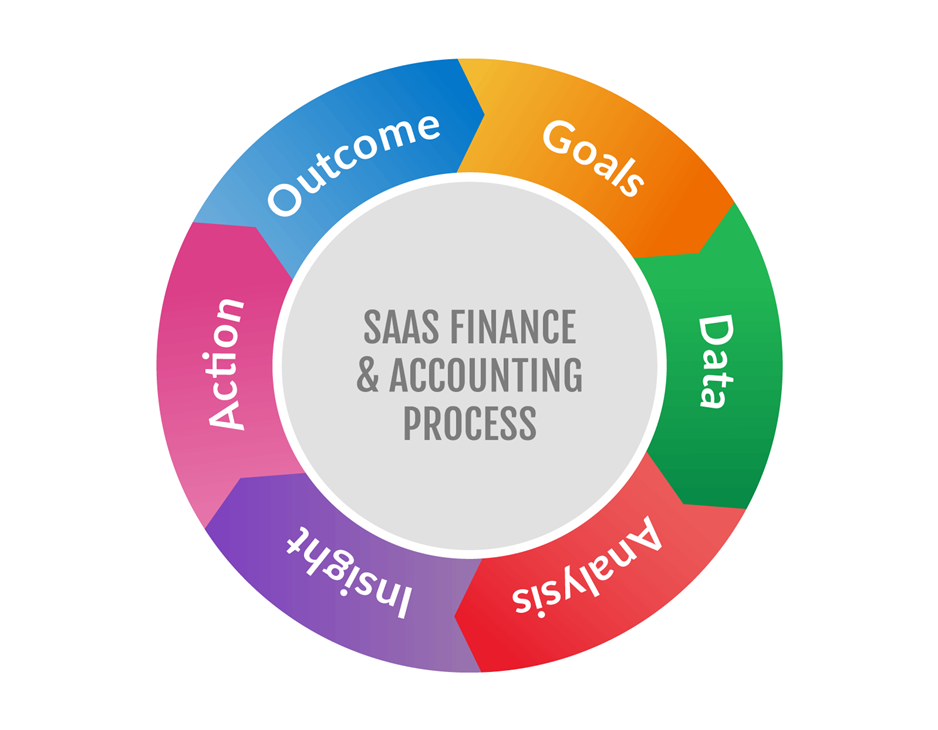
- Goals: Define monthly, quarterly, and yearly targets.
- Data: Report on the right metrics, accurately and consistently.
- Analysis: Evaluate the performance of your KPIs.
- Insight: Draw conclusions, identify trends, opportunities, and root causes.
- Action: Make informed decisions and implement strategic measures.
- Outcome: Assess results, set new goals, and repeat the process.
Chapter 6
Maximizing SaaS Valuation for Fundraising
and Exit
Understanding SaaS Valuation Methods
Every business is unique—with its own strengths, weaknesses, and marketplace challenges and opportunities —which brings many factors into play when valuing a SaaS company. There is no one-size-fits-all approach, but there is a guiding principle: The value of a SaaS company is not based on its current cash flow, but on its potential for future profitability. Founders, CEOs, investors, and buyers don’t have a crystal ball, but they do have metrics that serve as reliable indicators of future financial performance. The metrics that matter most will depend on several variables, such as the age of a SaaS business, its growth rate, the level of founder involvement, market conditions, and more. For example, Annual Recurring Revenue (ARR) has a major impact on valuation, but it’s far from the only sign. While ARR is the best measure of top-line revenue, it doesn’t account for profitability, churn, customer lifetime value, and other metrics that factor into long-term success. This is a nuanced discussion, especially if you’re comparing ARR to EBITDA for valuation. That’s why investors and buyers include much more in their due diligence. Unit economics are hugely important, because they provide a solid basis for the cash required for future growth and future profitability at scale. Here, churn, LTV, CAC, and LTV:CAC ratio are all measures of current performance that help gauge a SaaS firm’s growth potential. Profitable unit economics support higher valuation, as they translate into a lower overall investment and higher likelihood of future returns for shareholders.The Pillars of SaaS Valuation
Whether you’re weighing debt vs equity capital, or comparing private equity vs venture capital for an upcoming fundraising effort, or preparing for a big exit, each of your SaaS pillars—team, technology, metrics, and processes—will play a significant role. The key to maximizing valuation lies in how well they all come together.Your SaaS Finance & Accounting Team
Every team member must understand their role and how it impacts valuation. This begins with your Head of Finance ensuring department heads are fluent in SaaS metrics and are clear on the KPIs they own. As department heads, their role in due diligence is to add value by demonstrating how they are using SaaS metrics and how that will continue under new ownership in a way that creates even more value. Department heads must also clearly convey in diligence and management meetings that they own their department’s budgets.Technology Supports SaaS Valuation
A SaaS firm that hasn’t fully implemented a right-fit technology stack is at a disadvantage when it comes to valuation because they likely can’t accurately and efficiently respond to the deep probing that invariably occurs during due diligence. On the other hand, when a SaaS business is using dashboards and metrics to consistently and credibly respond with the right data, and leveraging best-in-class automation tools to streamline the process, their technology is truly adding value.Key SaaS Metrics Drive Valuation
Metrics must track the right areas of your SaaS business at each growth stage and present that information in a highly credible and actionable way. When consistent, accurate, timely data is routine practice, it sends a strong signal that everything behind it is operating efficiently.Process as a Value Driver
Process brings everything else together, ensuring the right team is using the right tools to generate the right data, resulting in confident decision making. The more effective a firm’s processes, the better they will avoid compliance headaches, audits findings, and other regulatory issues, as well—all key value drivers for a SaaS business.Managing the Exit Process with a SaaS CFO
Without high-level financial leadership and a comprehensive exit strategy, you could be leaving enormous value on the table. An experienced SaaS CFO will begin positioning your company for an exit years ahead of an actual sale, and will help you transition your team, technology, and processes through acquisition. Along the way, they will be responsible for pulling all the right levers to add value.Chapter 7
Outsourced SaaS Finance & Accounting Services:
A Scalable Solution
There’s a common thread that runs through successful, high-growth SaaS companies: Strong CFO leadership. Your CFO function sets the standard. They are responsible for building the right team, putting the right technology in place, defining the right metrics, developing the right processes, and driving enterprise value. And, they can do it all affordably by setting up systems and adding value on an as-needed basis as part of a fully-integrated team.
Getting each of these pillars right is critical for SaaS firms at every stage of growth. Even early-stage startups can benefit tremendously from CFO-level leadership, when it is part of a complete solution.
What does a complete SaaS finance and accounting solution look like?
It’s a flexible, team-based approach that always meets your needs. You’ll have access to high-level finance leadership. You’ll always have a deep bench of specialized expertise. You’ll save money by driving lower-value tasks to the appropriate resources. You’ll have a seamless transition at exit. Most importantly, you’ll have a partner with end-to-end ownership of the business function that drives value.
For some firms, it might be a fractional CFO on a project basis, with a fully-integrated accounting team. For other firms, it might be a full-time, dedicated CFO, a finance manager, a controller, and more. For your firm, it will be a tailored solution that scales with your needs.
To learn how an outsourced CFO service for SaaS businesses offers a complete solution for every stage of growth, schedule an introduction to Driven Insights. You’ll receive a free proposal and discover a cost-effective way to have all the finance resources your business deserves, today and as you grow.